Indonesian & Malay: The underrated language powering two of Asia’s top expat destinations
Author: Marketing Team

Malaysia and Indonesia are two of Southeast Asia’s most dynamic and rapidly growing economies, and both rank consistently among the region’s most popular expat destinations. Kuala Lumpur’s cosmopolitan business environment, Malaysia’s MM2H visa programme, and Bali’s extraordinary lifestyle appeal attract thousands of international professionals each year.
For those relocating to either country, Indonesian and Malay, essentially two closely related standards of the same language, offer one of the most accessible language learning opportunities in Asia.
Why Indonesian and Malay are excellent for expats
Bahasa Indonesia (Indonesian) and Bahasa Malaysia (Malay) are mutually intelligible languages sharing the same fundamental grammar and vocabulary, with differences comparable to those between American and British English.
Both are official languages of their respective countries, and a working knowledge of either will serve you well across both nations and into Singapore (where Malay is one of four official languages).
This linguistic proximity makes Indonesian/Malay an extraordinarily efficient language investment for professionals operating across Southeast Asia. Learning one opens meaningful doors in multiple markets simultaneously, a rarity amongst the world’s major languages.
Fun facts about Malay/Indonesian language
Indonesian and Malay are widely regarded as among the easiest Asian languages for English speakers to learn.
- Both are written in the Latin alphabet, use no tones (unlike Thai, Mandarin, or Vietnamese), have minimal grammatical gender, and do not conjugate verbs by tense.
- The same verb form is used regardless of who is performing the action or when it is taking place context and time markers convey meaning instead.
- The FSI classifies Indonesian as a Category II language, estimating approximately 900 hours to professional working proficiency considerably more accessible than most other Asian languages.
Motivated learners with structured tuition and in-country immersion typically reach strong conversational fluency within twelve to eighteen months.
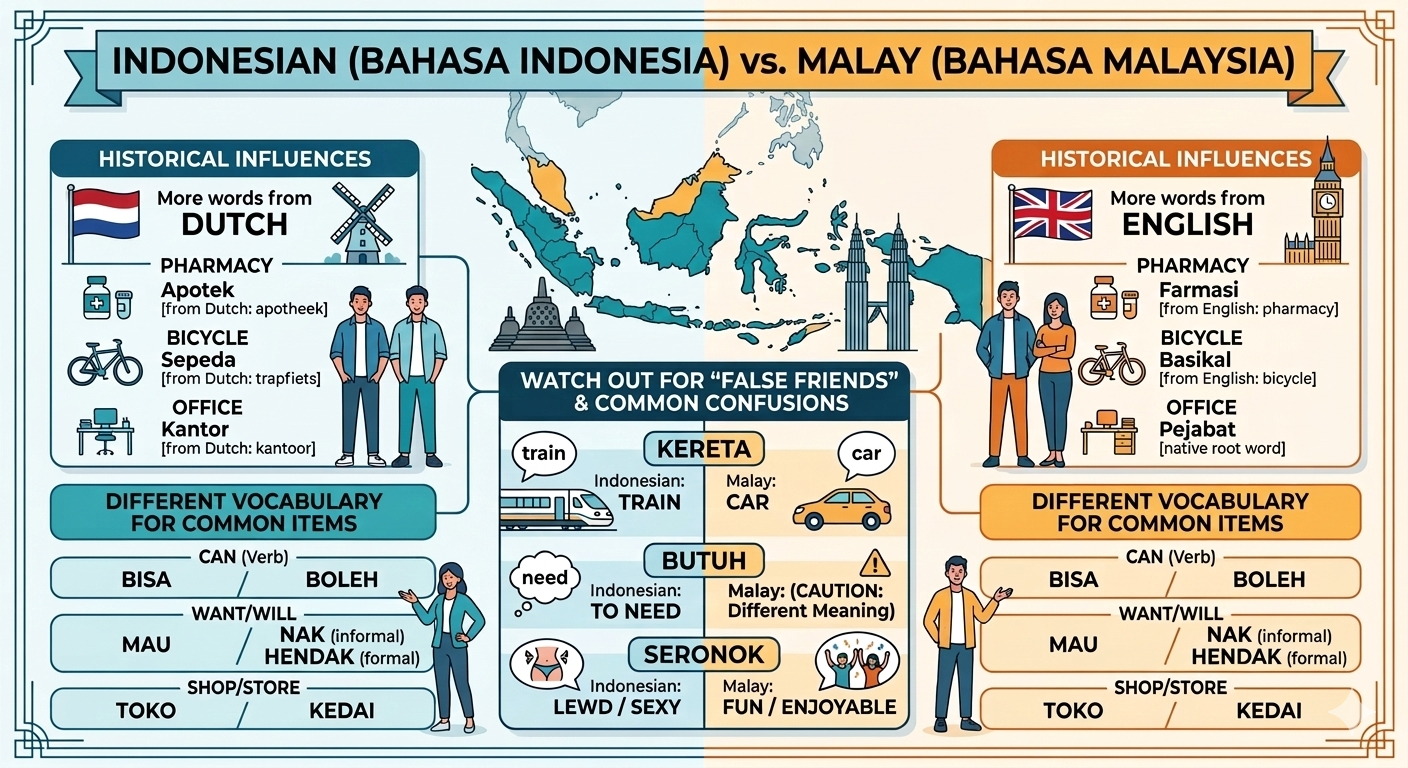
Malaysia: English and Bahasa in a multilingual environment
Malaysia is a genuinely multilingual society. English is widely spoken in business, government, and education, and Kuala Lumpur’s corporate environment is highly English-friendly. However, Bahasa Malaysia is the national language and is the language of official documentation, legal processes, and communication in many domestic-facing industries.
Professionals relocating to Malaysia who invest in Bahasa will find it significantly easier to navigate administrative processes, build deeper relationships with local colleagues, and engage meaningfully with Malaysian culture beyond the expatriate community. It also signals cultural respect in a country that takes considerable pride in its national language and identity.
Indonesia and Bali: Language as social capital
Indonesia is an archipelago of over 17,000 islands and more than 700 regional languages, but Bahasa Indonesia serves as the national lingua franca understood and spoken across the entire country.
In Bali the island that has become a focal point for international digital nomads and lifestyle expats Bahasa Indonesia is the practical language of daily life outside the tourist zones.
For professionals and remote workers based in Bali or Jakarta, Indonesian language proficiency transforms the quality of social integration and daily experience.
The warmth with which Indonesians typically receive foreigners who make the effort to speak the language is remarkable, and the practical benefits from negotiating accommodation to navigating health services are immediate and significant.
Practical tips for expat professionals
Take advantage of the relatively accessible entry point; begin Indonesian or Malay study at least three to four months before departure and aim to reach a basic conversational level prior to arrival.
Focus on practical vocabulary relevant to your professional context and daily life situation.
Using the wealth of online resources available for both languages there are excellent structured courses, vocabulary tools, and conversation practice platforms available for both Indonesian and Malay.
Engage with local communities in markets, food stalls, and neighbourhood interactions these contexts provide rapid, authentic practice in a language that is friendly to beginners.
Advice for employers and HR teams
For organisations relocating staff to Malaysia or Indonesia, Indonesian/Malay language training represents a high-value, relatively low-cost investment given the language’s accessibility. The relatively short time required to reach conversational fluency means pre-departure programmes can deliver meaningful results before an assignee even lands in their new country.
Organisations should consider pairing language training with cultural orientation covering the multicultural dynamics of Malaysia and the island-specific cultural nuances of Indonesian postings.
At MovePlus Mobility, we believe relocations are more successful when employees and their families feel comfortable engaging with local language and traditions. Whether through virtual lessons or in-person cultural training, we offer tailored language and cross-cultural programs that help assignees and expats settle in with confidence.
Recent Blogs
- Indonesian & Malay: The underrated language powering two of Asia’s top expat destinations
- Expat Highlight: 7 fun facts about the Mandarin language
- Expat Highlight: 7 fun facts about the Arabic language
- Why Spanish is the most valuable language you can learn as an expat
- Learning Thai: What every professional relocating to Thailand needs to know
Marketing Team
AuthorReady to Transform Your Global Mobility Strategy?
Connect with our mobility experts to discuss how MOVEPLUS™ can streamline your international talent management and relocation processes.